This medicine contains aspirin, which has many properties: analgesic and antipyretic, but also anti-inflammatory at high doses and blood thinner.
It is used in the treatment of fever, various pains and rheumatism.
Usual dosage
- Isolated pain, fever
Adults and children over 50 kg : 500 mg or 1 g (i.e., 1 or 2 sachets of 500 mg or 1 sachet of 1000 mg) per dose, to be repeated if necessary after a minimum period of 4 hours, without exceeding the dose of 3 g of aspirin per day (i.e., 6 sachets of 500 mg or 3 sachets of 1000 mg per day).
In the elderly , it is best not to exceed a dose of 2 g of aspirin per day (i.e., 4 sachets of 500 mg or 2 sachets of 1000 mg per day).
Children : 60 mg per kg per day, divided into 4 or 6 doses, i.e. 15 mg per kg every 6 hours or 10 mg per kg every 4 hours.
It is necessary to follow the recommendations of your pharmacist or doctor, or to follow the dosages given below as a guide:
- Children weighing 20 to 30 kg (approximately 6 to 9 years old): 1 sachet of 250 mg, to be repeated if necessary after 4 hours, without exceeding 6 doses per day
- Children weighing 30 to 40 kg (approximately 9 to 13 years old): 1 sachet of 500 mg, to be repeated if necessary after 6 hours, without exceeding 4 doses per day
- child weighing 41 to 50 kg (approximately 13 to 15 years old): 1 sachet of 500 mg, to be repeated if necessary after 4 hours without exceeding 6 doses per day.
- Rheumatic pains :
The dosage is 3 to 6 g of aspirin per day in adults and 50 to 100 mg per kg per day in children, under medical supervision.
Composition
Active ingredient: Lysine acetylsalicylate
Excipients: Ammonium glycyrrhizate, Glycine, Lactose, Mandarin flavor.
Contraindications
This medicine should not be used in the following cases: allergy to aspirin and NSAIDs, history of asthma caused by taking aspirin or NSAIDs, stomach or duodenal ulcer, bleeding and risk of bleeding, severe liver or kidney failure, severe heart failure, pregnancy (last trimester).



 Send a prescription
 News
News Advice area
 Events & entertainment
 All-night drugstore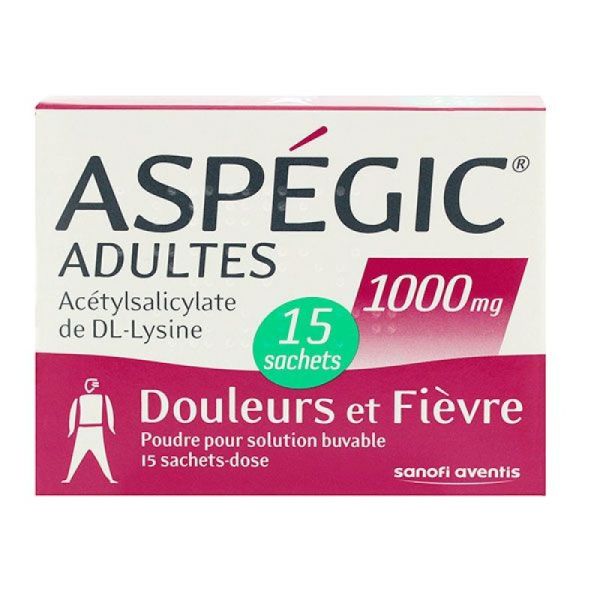

 Medications
  Parapharmacy
  Specials
 Brands