Step 1: Sample collection:
Insert a sterile swab into one of your nostrils and then swab the surface of the posterior nasopharynx.
Remove the swab from the nasal cavity.
Step 2: Sample preparation:
Pour the reagent into the extraction tube and then insert the swab.
Twist 5 times while squeezing the tube. Remove the swab by squeezing the sides of the tube, then replace the dropper cap.
Step 3: Performing the test:
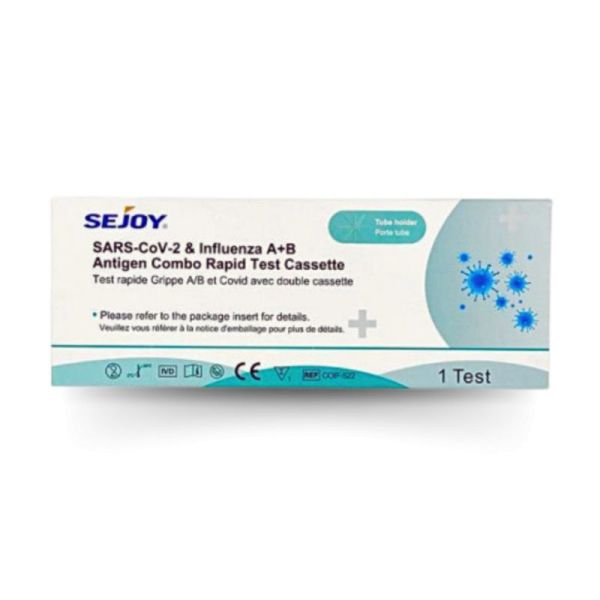
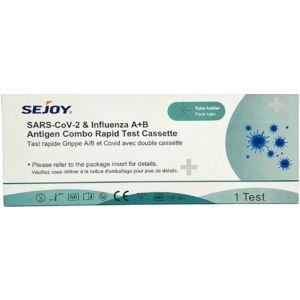
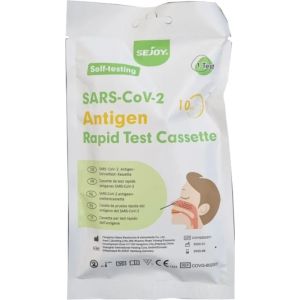
Place the test cassette on a flat surface and then deposit 3 drops of the solution into the sampling well.
Read the result 15 minutes later.
Step 4: Interpretation of the result:
Positive: A reddish control line (C) and a reddish test line (A, B/T) indicate that influenza A, B, and/or SARS-CoV-2 antigens have been detected. Lines at positions A and C indicate the presence of influenza A viral antigen, lines at positions B and C indicate the presence of influenza B viral antigen, and lines at positions T and C indicate the presence of SARS-CoV-2 viral antigen in the sample. A positive result does not rule out co-infections with other pathogens, nor does it identify a specific subtype of influenza A virus. Even a faint or light line should be interpreted as a positive result.
Negative: A reddish control line (C) only, with no test lines at positions A, B, or T, indicates that influenza A, B, or SARS-CoV-2 antigen was not detected. A negative result does not rule out influenza or SARS-CoV-2 viral infection. Negative results should not be determined before 15 minutes. Negative results are presumptive and must be confirmed by molecular testing.
Invalid: A reddish-purple line must always appear at the control line position (C). If a line does not form at the control line position within 15 minutes, the test result is invalid and the test must be repeated with a new device.



 Send a prescription
 News
News Advice area
 Events & entertainment
 All-night drugstore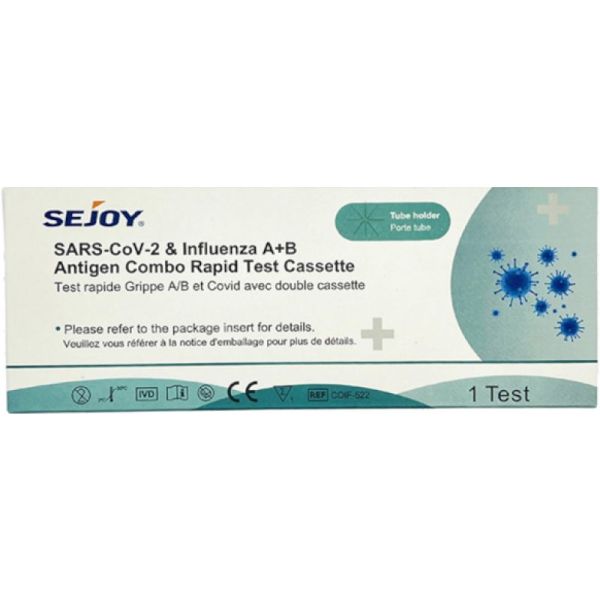

 Medications
  Parapharmacy
  Specials
 Brands